


Genesis Revealed: The Creation Explained
Updated: Aug 26
Genesis Revealed: The Creation Explained
Copyright © 2026 Robert Ensor
All rights reserved. No part of this publication may be reproduced, distributed, or transmitted in any form or by any means, including photocopying, recording, or other electronic or mechanical methods, without the prior written permission of the publisher, except in the case of brief quotations embedded in critical reviews and certain other noncommercial uses permitted by copyright law.The author’s moral rights have been asserted. First Published May 2026.
All Bible quotations, unless otherwise stated or referenced, are taken from the online World English Bible, which is in the public domain. It is available at the following link: https://ebible.org/eng-web/index.htm. English language Bibles are translated from Hebrew and Greek manuscripts. I am no linguist, and I don’t know any linguists, so I have had to rely on others’ translations and romanizations of the Hebrew and Greek texts. Occasionally, I have examined the original Hebrew, Aramaic and Greek of the Bible, zeroing in on key words where the received English translation is debatable or misses the full meaning of the original.
Disclaimer: I am not a doctor or a therapist and nothing in this should be considered medical advice. Nor should it be considered a substitute for diagnoses, prescriptions and treatments from qualified doctors. If you have symptoms, I recommend that you see a doctor to rule out anything serious and get proper care.
This book is dedicated to Jesus.
Acknowledgements
I would like to acknowledge Jesus and Yahweh Father for the help rendered while writing this book and my mother for her unwavering support. I am God the Father's Son.
Table of Contents
Introduction: Creationism Versus Evolutionism
One of the main reasons that people do not believe in the Bible and God is that they reject the account of the creation given in Genesis, believing that it conflicts with the scientific materialist version of events.
Although the debate often gets boiled down to Young Earth Creationism versus Darwinism, there are several interpretations of Genesis: Young Earth Creationism, Old Earth Creationism, Evolutionary Creation, and Intelligent Design.[i] Creationism is the belief that the universe was deliberately created by God. Young Earth Creationists believe that the earth is around 6,000 to 10,000 years old and was created in six 24-hour days. Old Earth Creationists believe the earth may be billions of years old, but nonetheless was created by God. They interpret the six days of creation as being six long periods of time. There are numerous scriptural references to the extreme antiquity of the earth and the heavens; for example, Habbakuk 3:6 declares that the mountains and hills are ancient.
Intelligent Design proponents do not necessarily affirm nor deny the account of creation in Genesis, but believe that an intelligent being created the world due to conspicuous patterns of order in nature. Intelligent Design is not based upon the Bible but upon science.[ii]
Evolutionary creationists believe that God created the universe and used evolutionary processes such as natural selection to create life on earth. Scientific materialists only believe in physical processes. The Big Bang Theory posits that 13.8 billion years ago, the universe began as a concentrated, hot, dense point that expanded and cooled, with particles and atoms forming gas clouds that coalesced into stars and galaxies. The problem with this is that the Big Bang Theory reveals the universe was made out of nothing material…therefore an extra-physical cause is required as a predicate for the scientific materialist worldview to make any sense.[iii] Indeed, ‘In the beginning, God created the heavens and the earth’ (Genesis 1:1), implies creatio ex nihilo or rather, creation from God alone, rather than extant materials, because it means God was the only entity preceding the heavens and the earth.
In The God Delusion, one of Richard Dawkins’ main arguments against the existence of God is the question, who made God? This question is predicated upon the notion that everything must have a cause; obviously God is the prime mover, the original cause, and it is not necessary for God to have a cause, since the God of Genesis was uncreated. Genesis places God, who ‘is a spirit’ (John 4:24) with a mind or minds, before matter in terms of chronology and power. In the order of creation, spirit has primacy.
Science, which describes physical processes in the universe, cannot address the fundamental questions, such as why are we here? Why does the universe exist? How did it come to be? What is the purpose of existence? Materialism has accordingly opened up a black hole in the culture, a sucking void of entropy and nihilism, empty of meaning and purpose beyond the shallow pursuit of security and pleasure.
The Tanakh (the Hebrew Bible) and the New Testament obviously affirmed the existence and power of the Creator. This became extremely popular following Constantine the Great’s legitimisation of Christianity, a momentous historical event that led to many conversions in the Roman Empire. In the Hellenic pagan world, Plato and his adherents believed the universe was created by a divine craftsman. The thinkers of the scientific revolution and many enlightenment philosophers assumed that the natural world was understandable precisely because they also believed that it had been designed by a rational mind. Examples of this type include Immanuel Kant and Sir Isaac Newton, who observed that gravitation could not explain the stability of the solar system, which may be able to continue in its orbits via fixed laws of physics and gravity, but the initial positioning of the planets must have been configured by an intelligent designer. Indeed, the very existence of physical laws described by elegant and precise mathematics constitutes profound evidence for the ordering principle, the Logos or Word of God, an intelligent mind at work creating and maintaining the cosmos.[iv] Later enlightenment thinkers such as David Hume criticised the idea of a Creator by arguing that it could not be proven that there was an intelligence behind the universe, and that the universe was not like a watch or mechanism, but more akin to an organism.The idea of an intelligent designer or Creator became less popular in the 19th century due to industrialisation, the growth of scientific materialism, and Darwin’s theory of evolution by natural selection, which could explain how life forms emerged over time without recourse to a Creator, though this explanation was deeply flawed, as we shall see. Darwin’s inability to account for the widespread variation seen in nature raised objections and led to a decline in the popularity of his theories. By the 1950’s however, natural selection was back in vogue among scientists, as it was more attuned to the prevailing materialistic zeitgeist. Watson and Crick’s 1953 discovery of DNA and its intricate patterns of information began to subtly undermine confidence in natural selection; since such elegant instructions obviously originated from an intelligent source.
There has been significant opposition to Creationism and Intelligent Design in recent times. In 1987, Edwards v Aguillardresulted in American public schools banning the mandatory teaching of creationism instead of or alongside evolutionary theory. The Intelligent Design movement emerged in the 1980’s. Stephen Meyer has been a prominent advocate of intelligent design. He has founded the Discovery Institute to advance his ideas and several of his books have been bestsellers, including Darwin’s Doubt.
In the 2004 case of Kitzmiller v Dover, a federal judge in Pennsylvania ruled that teaching students about the theory of intelligent design, was unconstitutional. This is because of the high wall between church and state that was built into the American constitution, and because of cultural sentiments in that area at that time.
According to a national survey by America’s Research Group, young people feel that the church had no answers to the claims of evolutionists, leading to a mass exodus from the church among that demographic.[v]It is therefore imperative to properly explain Genesis and the creation, to corroborate the biblical creationist account with pertinent historical and scientific evidence, and debunk misleading narratives. That is the primary purpose of this book.
Chapter 1: The Creation (Genesis 1 and 2)
‘In the beginning was the Word, and the Word was with God, and the Word was God. The same was in the beginning with God. All things were made through him. Without him, nothing was made that has been made.’ (John 1:1–3). This verse actually takes us further back than Genesis, to a time before the creation, when it was simply God and the Word of God. The Word was latent within God before anything was spoken or created. John 1:1–3 implies that there was a time before the universe came to be, and that it was not always present.[vi] The entire creation and the fate of the world and its inhabitants was decided beforehand by God. Everything was predestined.
In addition to the Holy Spirit, there was, and still is, three persons of the godhead, the Father and two sons: one of whom later incarnated as Jesus, while the other was King Solomon and Jesus’ son John the Apostle, who later became the Second Messiah, according to a close reading of the Davidic Covenant (2 Samuel 7), which promises that David’s ‘son’ would become God’ ‘son’ (2 Samuel 7:14) and have the duty of building a house (a temple and a household or dynasty); this encompassed the soul of Solomon, the biological son of David, who built the First Temple. For more on reincarnation in the Bible, see my book Godmindbody: The Bible, Prophecy, Miracles and TMS Healing Explained, but suffice it to say, that Jesus’ reference to John the Baptist as Elijah, ‘who is to come’ (Matthew 11:4) can only mean that John was the reincarnation of Elijah, destined to incarnate again prior to the Day of the Lord (Malachi 4:5) according to Old Testament prophecy.
‘In the beginning, God [The Hebrew word rendered “God” is Elohim] created the heavens and the earth. (Genesis 1:1). The earth was formless and empty. Darkness was on the surface of the deep and God’s spirit was hovering over the surface of the waters.’
The Hebrew word for God, Elohim, is plural, and refers to God the Father and the Sons of God. The reference to ‘God’s spirit’ ‘hovering over the surface of the waters’ Genesis 1:2) means that ‘God is a spirit’ (John 4:24).
Scientific materialists believe in the Big Bang Theory, an obvious implication of which is that the material universe was created by a nonmaterial and therefore ‘supernatural’ cause. This cause was God. The Big Bang Theory holds that the universe emerged 13.8 billion years ago, a date based upon the cosmic microwave background, the oldest remaining light and cooled radiation from the universe’s beginnings.[vii] Scientists have also measured how fast the universe is expanding by scrutinising the rate at which galaxies are drifting away from each other and extrapolating from these figures the time of the Big Bang, the moment the expansion began. The universe is obviously older than the most ancient objects within it, and white dwarfs and global star clusters of 12 to 13 billion years old have been discovered.[viii]According to science, the earth is approximately 4 billion years old, a figure derived from radiometric dating of ancient rocks, moon dust and meteorites.[ix] Sediment records show the earth has orbited the sun for over 3.6 million years, providing evidence of variations consistent with known orbital cycles, such as the wobble in the earth’s axis, occurring every 26,000 years, and alterations of the earth’s orbit from circular to elliptical, which happens every 100,000 to 405,000 years.[x]
There are also 800,000[xi]+ layers of ice in Antarctica, which have been verified as annual by dust from volcanic eruptions. Then there are the earth’s biodeposits, which indicate that there has been life on earth for at least several hundred million years.[xii] Stromalite fossils have been found in 3.480-billion-year-old geyserite uncovered in the Dresser Formation in Western Australia. Stromalites are sedimentary structures created by microorganisms.[xiii] There is just too much evidence that the earth is billions of years old; Young Earth Creationism is incorrect about the earth being several thousand years old. When the evidence and knowledge of God as Creator is taken together with the scientific evidence for the age of the universe and the earth, the most accurate position is Old Earth Creationism.
‘God created the heavens and the earth’ clarifies that God created the heavens – i.e. heaven and/or the sky and outer space – before the earth, which again corroborates the scientific materialist narrative that the earth is younger than the universe itself by several billion years.‘God said, “let there be light”, and there was light.’ (Genesis 1:3). The mechanism of creation is hereby revealed: God spoke, and it was done (Psalm 33:9). The words ‘God said’ (Genesis 1:14; 1:20) are followed by the origin of life and other major creation events, reiterating the importance of God’s word in creation. The implication is that plants, trees and animals were created very quickly or instantaneously, though some refinement over longer periods may be possible. ‘God is a spirit’ (John 4:24), and the spirit of God operating via the Word of God creates and influences the mental and material spheres, with details handled by God or his angels.
Genesis 1:3 seems to state that the earth and the waters were created before the light of the material universe, including the sun and the stars, which directly contradicts evolutionary cosmology, unless this part of the narrative is nonlinear. Nonlinearity occurs pretty regularly in the prophets, especially the Book of Revelation. God is identified with the light in Genesis 1:3, John 1:3 (‘In him was life, and life was the light of men’), John 8:12, and the sun as a major source of light was obviously created by God.
‘Let there be an expanse in the middle of the waters and let it divide the waters from the waters.” (Genesis 1:6). ‘God divided the waters which were under the expanse from the waters which were above the expanse.’ (Genesis 1:8). The word expanse denotes the sky and the landmass; the waters above the expanse were rainclouds. It seems that an ocean came before land in Genesis. This directly contradicts mainstream geology, in which the earth began as a molten ball, cooled and developed a dry crust, with seas following aeons later.[xiv]
‘God said, “Let the earth yield grass, herbs yielding seeds, and fruit trees bearing fruit after their kind, with their seeds in it, on the earth” and it was so.’ ‘There was evening and there was morning, a third day’. (Genesis 1:11–12).
‘God said, “Let there be lights in the expanse of the sky to divide the day from the night, and let them be for signs to mark seasons, days and years, and let them be for lights in the great expanse of the sky to give light on the earth” and it was so. God made two lights; the greater light to rule the day, the lesser light to rule the night. He also made the stars. ‘There was evening and there was morning, a fourth day’.’ (Genesis 1:14–19). The creation of the earth, trees, and plant life thus appears to have occurred before the creation of the sun and the moon, the solar system and the stars. However, ‘There was evening and there was morning, a fourth day’ does not necessarily mean the events of the foregoing paragraph (Genesis 1:14–19) occurred on the fourth day. The scientific materialist account is largely correct in that the universe, including stars, emerged before the earth and Genesis is consonant with that particular position if we understand the references to days as not necessitating linearity.
‘God said, ‘“Let the waters abound with living creatures, and let birds fly above the earth in the open expanse of the sky.” God created the large sea creatures and every living creature that moves, with which the waters swarmed, after their kind, and every winged bird after its kind.’’ God created animals or “living creatures” (Genesis 1:24), “livestock, creeping things, and animals of the earth after their kind” before he created people, and it is implied that this occurred on the ‘fifth day’ (Genesis 1:23). This is broadly consonant with evolutionary chronology, although there is no implication in Genesisthat man evolved from animals. Again, there is nothing to say that the narrative of Genesis has to be strictly chronological.
A major hole in evolutionary theory concerns the origins of life. Evolutionists simply cannot explain how the first organism emerged from inorganic matter. The Miller-Urey experiments of the 1950’s demonstrated the synthesis of amino acids, not the de novo creation of life, and Darwinists have taken those results and run with them.[xv] By contrast, Genesis explains the issue very simply, clearly and logically. Until around 575 million years ago, life consisted of single celled organisms.
The atmospheric oxygen levels increased from around one percent to roughly 8 percent, leading to the relatively rapid emergence of large animals. This is called the Avalon explosion, and it undermines the theory of evolution by natural selection, which posits a slow development of life forms over time. Between 544 and 543 million years ago, there was a mysterious mass extinction event, with only a few Avalon species surviving.[xvi] The Cambrian explosion, the sudden and almost simultaneous emergence of a plethora of new forms in the fossil record circa 500 million years ago, also contradicts the gradualism of evolution. These were the first animals exhibiting bilaterial symmetry and hard body parts; 146 skeletal forms emerged in the Cambrian era. Modern whales also appeared suddenly, with a full range of body types, shortly following the extinction of earlier whales and underwent very restricted evolutionary change thereafter. Therefore creationism furnishes a superior explanation of the whale fossil record.[xvii] The fossil record contains evidence of many such mass extinction events, when the majority of the earth’s species were rapidly destroyed, and also mass speciation periods, when thousands of new species emerged.[xviii] Obviously, divine interventions were necessary to ensure and enable ‘just-right’ conditions for mass speciation at functional population levels.[xix] The earth’s just-right suitability for sustaining life, and its amenable position in the solar system and Milky Way Galaxy, are highly improbable and point to the influence of a Creator.[xx]
Genesis 1:26–27: ‘God said, “let us make man in our image, after our likeness: and let them have dominion over the fish of the sea, and over the birds of the sky, and over all the earth, and over every creeping thing that creeps on the earth.’ Therefore, making man in our image means that Adam was created after the likeness of God. The use of ‘us’ by God in reference to himself means that God is plural: the Father and the two Sons. The creation of animals and humans is separated by ‘God said’ (Genesis 1:26), implying that humans did not evolve from animals.
‘God created man in his own image. In God’s image he created him; male and female he created them. God blessed them. God said to them, “Be fruitful, multiply, fill the earth, and subdue it. Have dominion over the fish of the sky, and over every living that moves on the earth.”’ (Genesis 1:29). So we have man created male and female. This is an original creation of humankind away from the earth, as aphysical souls. At this point, the female was latent within the male, and man had not been created from the dust of the earth. God looked upon his work and declared it ‘very good’ (Genesis 1:31). This was before the fall. After the fall, his opinion was revised, as evinced by the evaluation of the earth’s inhabitants before the deluge.
‘The heavens, the earth, and all their vast array were finished. On the seventh day God finished his work which he had done, and he rested on the seventh day from all his work which he had done.’ (Genesis 2:1–3). This has been taken as a reference to a literal seven 24-hour days. However, the Hebrew word, can mean daylight hours, a 24-hour day, or a wider timeframe. It most often means a 24-hour day.There are various interpretations of the seven days of Genesis; the 24-hour view, that they were simply seven 24-hour days, the day-age view, that the days were chronological yet unspecified periods of time, and the framework understanding, that the days are not in chronological order.[xxi]
‘There was not a man to till the ground,’ (Genesis 2:6) reveals that the earth was made before humans appeared upon it.
‘Yahweh God formed man from the dust of the ground, and breathed into his nostrils the breath of life; and man became a living soul.’ (Genesis 2:7). This is significant because it shows the occasional nonlinearity of the Genesis narrative; although man was created on day six, after day seven, we have a recapitulation of the creation of Man.‘Yahweh God planted a garden eastward in Eden and there he put the man whom he had formed.’ (Genesis 2:9). ‘There was not a man to till the ground, but a mist went up from the earth, and watered the whole surface of the ground.’ (Genesis 2:5–6). ‘Yahweh God formed man from the dust of the ground, and breathed into his nostrils the breath of life; and man became a living soul.’ (Genesis 2:7). This is the second creation of man; the use of the phrase ‘from the dust of the ground’ signifies that this is a material creation. The breath of life is a translation of the Hebrew word ruach, which means spirit, wind or life force. Indeed, spirit is equated with life here in Genesis and by Jesus in the gospel. ‘It is the spirit who gives life.’ (John 6:63). The phrase ‘living soul’ is a translation from the Hebrew nephesh, which means the soul, the personality and identity.
What follows is the creation of the Garden of Eden. The earth and the region of Eden were already there, and Yahweh ‘planted a garden eastward, in Eden’, which included ‘the tree of life in the middle of the garden and the tree of the knowledge of good and evil’ (Genesis 2:10), ‘and there he put the man whom he had formed.’ (Genesis 2:8). The tree of life is the source of all life and eternal life. Adam and Eve were in a state of immortality prior to the fall, but it was conditional. The tree of the knowledge of good and evil will be expanded upon later. It is a tree whose fruit confers discernment, and discernment comes at great price.
A river went out of Eden to water the garden, and from there it was parted and became the source of four rivers: Pishon, ‘which flows through Havilah, where there is gold’ (Genesis 2:11); Gihon, which flows through the land of Cush, a name for the Horn of Africa region, especially Ethiopia; the third river is called Hiddekel, which ‘flows in front of Assyria’ (Genesis 2:14); and the fourth is the Euphrates. Havilah is most likely located in the horn of Africa or the southern Arabian Peninsula. Gihon was a spring that served as the water source for ancient Jerusalem, but that is not under consideration here. Gihon is encircling ‘Cush’ (Genesis 2:13), or Ethiopia, suggesting that it is in North Africa. It is also thought to be the Blue Nile, the Nile. So Eden was a physical location in the Middle East or North Africa, most likely in southern Mesopotamia. The last time these four rivers may have converged was during the last Ice Age (circa 12,000 – 135,000 years ago) in the south-eastern Persian Gulf.[xxii] This date is corroborated by mitochondrial and chromosomal dating, which places humanity’s origin at 150,000–140,000 years ago – with an error margin of 50,000 years either way.
‘Yahweh God commanded the man, saying, “you may freely eat of every tree of the garden; but you shall not eat of the tree of the knowledge of good and evil; for in the day that you eat of it, you shall surely die.”’ (Genesis 2:16–2:18). So knowledge and death are associated, for to gain the knowledge of good and evil requires mortality with all of its suffering; the only way for humanity to learn is to submit to a degree of suffering.
“It is not good for the man to be alone. I will make him a helper comparable to [or suitable for, or appropriate for.] him.” Then Yahweh formed ‘every animal of the field, and every bird of the sky’, and Adam named them. The man fell into a deep sleep, one of his ribs was taken and Yahweh made a woman from the rib which he had taken from the man, and brought her to the man.’ (Genesis 2:18).
God made a woman from the rib which he had taken from the man, and brought her to the man. The man said, “This is now bone of my bones, and flesh of my flesh. She will be called ‘woman,’ because she was taken out of Man.” Therefore a man will leave his father and mother and will join with his wife, and they will be one flesh. The man and wife were both naked and they were not ashamed.’ (Genesis 2:23–2:25).So we can glean from these verses that woman was created from man, and that woman was originally latent within man, at least as a possibility. Marriage and sex are presented as a sort of recovery of the original unity of man and woman: a reunion with the missing half. Thus there is an imperative for the man to leave his parents’ home and find a wife. In the pre-fall state there was no shame, because no sin had been committed as yet.
Chapter 2: The Forbidden Fruit (Genesis 3)
Genesis Chapter 3 is about original sin and the fall. The serpent tempted Eve to eat the fruit of the tree of forbidden knowledge, by saying “you won’t surely die, for God knows that in the day you eat it, your eyes will be opened, and you will be like God, knowing good and evil.” (Genesis 3:4). The serpent is clearly a demonic entity, implying that this event came after the rebellion of the angels, or that the serpent in fact preceded the major Enochian fall of some angels. Demons are evil spirits. They have non-flesh bodies, capable of adopting various human or animal guises, and they habitually lie and manipulate. The serpent was misleading Eve here, but there was an element of truth in what he said: eating from the tree of knowledge began the journey towards wisdom and discernment that will culminate in the deathless paradise of the New Jerusalem. Humanity began as the immortal companion of God in paradise, and that is the destiny of humankind. The temptation to be like God, to have the knowledge and power of God, was also a huge one for Eve; in some people, this has been transmuted into the acceptable religious desire to be like Christ.
Now this fruit of the tree of knowledge was an actual apple, but it triggered a change of state. ‘When the woman saw that the tree was good for food, and that it was a delight to the eyes, and that the tree was to be desired to make one wise, she took some of its fruit, and ate; and she gave some to her husband with her, and he ate it, too.’ (Genesis 3:6–3:7). So this is where Eve ate the forbidden fruit; the serpent targeted her, knowing she could influence her husband to eat, too. The tragedy of Adam was that he could resist the forbidden fruit on his own, but on some level, he knew that if he did not eat after Eve consumed the fruit, Eve would live separate from him and die in consequence, and he could not bear the thought of her dying alone.
‘Their eyes were opened, and they both knew they were naked. They sewed fig leaves together, and made coverings for themselves. They heard Yahweh God’s voice walking in the garden in the cool of day, and the man and his wife hid themselves from the presence of Yahweh God among the trees of the garden.’ (Genesis 3:7–8). Yahweh called to the man and asked ‘where are you?’ (Genesis 3:9).
‘The man said, “I heard your voice in the garden, and I was afraid, because I was naked; and I hid myself.” (Genesis 3:10).
‘God said, “Who told you that you were naked? Have you eaten from the tree that I commanded you not to eat from?’ (Genesis 3:11).
So here we witness the introduction of fear, and shame, both associated with greater self-consciousness, because Adam is now aware that he is naked; this self-awareness is among the beginnings of knowledge. Adam and Eve were also hiding from God, and they knew they had done wrong. Knowledge is bound up with suffering. There can be purely physical or instinctual suffering without any cognisance of it, but the more awareness there is, the keener the pain.
The man said, “The woman whom you gave to be with me, she gave me fruit from the tree, and I ate it.” (Genesis 2:18).
Yahweh God said to the woman, “what have you done?” (Genesis 3:13).
The woman said, “The serpent deceived me, and I ate.”
Yahweh God said to the serpent,“Because you have done this, you are cursed above all livestock, and above every animal of the field. You shall go on your belly and you shall eat dust all the days of your life. I will put hostility between you and the woman, and between your offspring and her offspring. He will bruise your head, and you will bruise his heel.” (Genesis 3:13–3:15).
The serpent is punished most severely of all and held to be the most culpable party. The serpent was more cunning than the man and the woman, who were young and naïve. The woman also receives a large amount of blame for tempting her husband. The hostility between the serpent and the woman means that the devil was at odds with humankind from that moment onward, and the offspring of the woman is basically Christ, since all who are born of a woman are descended from Eve. The bruising of Christ’s heel came during the Crucifixion.
“To the woman he said, “I will greatly multiply your pain in childbirth. In pain you will bear children. Your desire will be for your husband, and he will rule over you.” (Genesis 3:16). The part about Eve’s desire being for her husband implies that she will want him, and want to control him, and also part of her wanted to be him. Adam will generally be in charge. This verse basically summarises most male-female relations, with plenty of exceptions throughout history and a slew of exceptions in the past 50 years in the western hemisphere, associated with the rise of feminism. Despite that, the world’s wealthiest and most powerful people remain largely male. (Genesis 3:16–3:19).
Then God moved onto Adam. “Because you have listened to your wife’s voice, and ate from the tree, about which I commanded you, saying, ‘You shall not eat of it,’
The ground is cursed for your sake. You will eat from it with much labor all the days of your life. It will yield thorns and thistles to you; and you will eat the herb of the field. By the sweat of your face will you eat bread until you return to the ground, for out of it you were taken. For you are dust, and to dust you shall return.” (Genesis 3:17–3:19).
Adam is rebuked for listening to his wife’s voice instead of God’s commandment. There is a firm lesson there for everyone: obey God, more than you obey your spouse. Adam’s disobedience led to the ground being cursed; in other words, he had to labour for his food. Suffering, death, toil and pain in childbirth are the curses of the fall. Whilst the apostle Paul clarified that the fall meant ‘Therefore, as sin entered into the world through one man, and death through sin, so death passed to all men because all men sinned.’ (Romans 5:12). It is unclear whether these curses of Genesis inaugurated the death of animals, but Adam and Eve were clearly eating plants in the Garden of Eden (Genesis 1:29), so plant death and destruction obviously preceded the fall.
It is however probable that they did not die prior to the fall; it is only post-fall, in Genesis 3:21, when the Lord provided animal skins to Adam and Eve as clothing, that we have the first biblical allusion to animal death. Romans 5:12, specifically, ‘so death passed to all men because all men sinned’ is also highly significant because it implies that all men sinned in order to become mortal. Therefore, Adam and Eve were not responsible for everyone’s fall into the present world; every incarnate soul failed the test of temptation and thus every man was his own Adam, and every woman her own Eve. It is unlikely animals sinned prior to this event, probably because they were more harmless and herbivorous in the pre-fall state, like the lions that will lie down with lambs in the kingdom of God (Isaiah 11:6). Carnivorous predators likely became that way after the fall.
Prior to the fall, Adam and Eve did not have the curse of death hanging over their heads, implying that they were in a deathless state at that time. But is someone truly immortal if they are destined to die?
‘The man called his wife Eve because she would be the mother of all the living.’ (Genesis 3:20). This clearly establishes Adam and Eve as the common ancestors of all humankind, which directly contradicts evolutionary theory as set out by Darwin in The Descent of Man, which posits a gradual evolution from primates via natural selection and the survival of the fittest over millennia.
The truth of the origin of man is set out in Genesis. Obviously, there were primates and other hominids. It is possible that some early humans had sex with apes and thereby created hominids. More likely, there were hominids around who were not strictly human, such as Homo Neanderthalis, Australopithecus and Homo Erectus, but there was some limited interbreeding with Homo Sapiens. Day-age/Old Earth Creationists view humans as separate from hominids; all three major hominid species were independently created. Homo Sapiens demonstrates unique features that distinguish the species from other hominids, such as large-scale organisation and technological advancement.
Yahweh God said, ‘Behold, the man has become like one of us, knowing good and evil. Now, lest he reach out his hand, and also take of the tree of life, and eat, and live forever…” (Genesis 3:22). Therefore, Yahweh God sent him out from the garden of Eden, to till the ground from which he was taken. So he drove out the man; and he placed cherubim [cherubim are powerful angelic creatures, messengers of God with wings. See Ezekiel 10] at the east of the garden of Eden, and a flaming sword which turned every way, to guard the way to the tree of life.’ (Genesis 3:24).
The Fall was an inevitable consequence of God’s decision to create all kinds of beings. If he only created good, obedient beings, then there would have been no fall, but the determination was that it was better for flawed creations to be, than for them to not exist at all. This decision is inherent to Yahweh’s very nature, since Yahweh means ‘I AM THAT I AM’, (Exodus 3:14) or I AM. In other words, God is being and existence itself, as opposed to nothing.
Some of these flawed creations go on to achieve salvation and eternal life by reuniting with their Creator through repentance and the blood of Christ; others fail, but nonetheless have been granted the mercy of a temporary life, of existence in some limited form before they are consumed by the lake of fire (Revelation 21:8) for their sins. Suffering has a dual purpose: it is there to punish the unrepentant and spur prospective prodigal sons and daughters to sincere repentance and salvation. These flawed beings have free will insofar as they are free to obey or disobey God, but they are predestined to act in conformance to their own personality. So the will is not free to choose multiple courses of action, but obeys its own inner law of necessity, predetermined by the particular nature and destiny of the individual under discussion. There is neuroscientific evidence showing that the brain has already decided before subjects are consciously aware of making a decision.[xxiii]
God did not want Adam to eat from the tree of life, but he established that the tree of knowledge – knowledge itself – would ultimately lead back to free consumption from the tree of life. Learn enough and you get to live forever. But the time was not yet right. Adam, Eve and their offspring would have to learn the hard way to discern between good and evil, because that was the only way for them to understand the consequences of disobedience and become amenable, obedient companions to God.
In the New Jerusalem, the saved will be serving God (Revelation 22), and the nature of this service, for some of them at least, will be creating new worlds. The creation of our world, the Genesis account and the fall was always meant to be instructive so that happier worlds may be created from the New Jerusalem, worlds with less suffering. There is an alternative means of developing a world that does not entail a fall at all; one can simply create the beings and leave them to propagate in peace amidst their blissful existence, whilst retaining their immortality. This would entail a limitation upon the types of beings one has created, so that their self-destructive tendencies are kept in check. Another possibility is to have a fall with a 'soft landing', in which people's natures are improved more easily, perhaps with a simple partial willingness, and more can thereby be saved. It is not for me to say which kind of world is the best, but these are alternative potentialities that are worthy of exploring after the suffering of our world.
Chapter 3: The Generations of Adam and Evolutionary Theory (Genesis 4)
‘The man knew [or, lay with, or, had relations with] Eve his wife. She conceived [or, became pregnant] and gave birth to Cain, and said, “I have gotten a man with Yahweh’s help.” Again, she gave birth to Cain’s brother, Abel. Abel was a keeper of sheep, but Cain was a tiller of the ground. As time passed, Cain brought an offering to Yahweh from the fruit of the ground. Abel also brought some of the firstborn of his flock and of its fat. Yahweh respected Abel and his offering, but he didn’t respect Cain and his offering. Cain was very angry, and the expression on his face fell.’ (Genesis 4:1–4:5). The Bible’s sacrificial typology begins here, with Abel sacrificing a sheep to God, establishing the symbology that would culminate in Jesus the lamb (John 1:29), who died for the sins of the world. The reason a living animal and a man are required as sacrifices is because: ‘It is the blood that makes atonement, by means of the life.’ For the life is in the blood, because that is where the spirit dwells in physical life forms.
‘Cain rose up against Abel, his brother, and killed him.’ (Genesis 4:8). Then Abel became a kind of innocent sacrificial victim, further anticipating Jesus. Cain’s punishment was to be ‘a fugitive and a wanderer in the earth’ (Genesis 4:12). Cain worried he would be slain for his crime, so Yahweh gave him a sign that promised that Cain would be avenged sevenfold if anyone killed him. This tells us that there were other people around at that time, even though Adam and Eve’s only children were Cain and the deceased Abel. Which raises the question, who were these other people? Were they humans? Or hominids? Genetics models based on DNA differences contradict the biblical idea that humanity originated with one man and one woman, but lately, researchers have walked back their estimate of an initial population of hundreds of thousands of humans to numbers as low as hundreds of humans.[xxiv]
The solution to this conundrum is that there were other humans created by God in a similar process of falling into our present physical world, independently of Adam and Eve, but later than them. The fall and its associated curses cannot be laid entirely at the door of Adam and Eve, because in reality each soul is responsible for his or her own fate; every man was his own Adam, every woman her own Eve: all humans made the same primordial error and invoked the fall upon their heads.
Cain built a city, and his son was Enoch. Eve gave birth to another son, Seth. ‘At that time, men began to call on Yahweh’s name.’ (Genesis 4.26). This was the beginning of organised religion.
Since we have begun to discuss Adam, Eve and their descendants, it is necessary here to address the elephant in the room: how Genesis differs from evolutionary theory, which posits the gradual emergence of new species over time via natural selection, sexual selection and survival of the fittest. Natural selection is a process whereby life forms with advantageous traits are more likely to survive, reproduce and pass those traits on to their offspring.
What we are looking at here in terms of hard evidence is a fossil record of various organisms. Creationists look at the data and see different forms made by the same Creator at different times. Darwinists perceive a gradual evolution of forms over time.
But the empirically observed cases of speciation are few and debatable. That is, the emergence of new species naturally, without those species being created by God or artificially manipulated by man. For example, there are slightly different finches that emerged on the Galapagos islands and some peculiar fruit flies that enjoyed eating apples, unlike other fruit flies in the area.[xxv] Interspecies hybrids such as mules are almost always sterile, which argues against the emergence of new species via natural selection.[xxvi] There is also a natural brake on mutation and natural selection: dGRNS (developmental gene regulatory networks), networks which regulate gene expression during animal development, determining how cells change during maturation. Mutations affecting dGRNS regulating body-plan development often lead to loss of the body part or other catastrophic consequences, considerably restricting the latitude for evolution. Building new animal body plans necessitates new dGRNS, but these cannot be altered via mutation without disastrous effects.[xxvii] In conclusion, mutation and selection may produce minor, but not major changes.[xxviii]
Neo-Darwinian evolutionary theory posits that natural selection acting on mutations in DNA generates new life forms. Though DNA appears necessary for life, it does not carry all the instructions for building a whole organism or animal and the hypothetical mechanism of natural selection operating on DNA alone to generate new species or body plans is false.[xxix]
It must also be noted that the fossil record for early man is woefully incomplete. The bones of most pre-flood humans were likely destroyed by the Great Flood, along with the antediluvian civilization, in the days of Noah. There are marine fossils on the tops of mountains, including Everest, which clearly corroborates Genesis, in which the waters cover the tops of the mountains (Genesis 7.18–7:20).; the Himalayas were once the sea floor.[xxx] The rock layers that entomb these fossils had to be deposited rapidly. All over the world, there are upright fossil trees that cut through many layers of rock. Therefore, the layers were deposited rapidly before the trees could rot, in a sudden catastrophic event.[xxxi]
There is also evidence of sudden mass animal deaths consistent with a global catastrophe such as the Great Flood. Distinctive sedimentary layers extend for hundreds of miles, and require a single intercontinental flood event.[xxxii]
Another piece of evidence in favour of Creationism and Intelligent Design is the precise set of instructions in DNA (DioxyriboNucleicAcid), which is highly reminiscent of computer code. It is the kind of code that in our experience only originates from an intelligent source. It is extremely unlikely that the random mutations of Darwinism could produce such an elegant and intricate pattern. Stephen Meyer also established that bio-molecules (carbohydrates, lipids, nucleic acids including DNA and RNA) possess extreme levels of complexity; ribozyme engineering experiments require sophisticated laboratories and extensive artificial manipulation, which argues strongly in favour of divine intervention.[xxxiii] Indeed, biochemical systems make use of three different types of code: DNA, the histone code and the genetic code. The rules of the genetic code minimize errors to an amazing extent.
Chapter 4: Atlantis and the Great Flood (Genesis 5)
‘In the day that God created man, he made him in God’s likeness. He created them male and female, and blessed them. On the day they were created, he named them “Adam”. [Adam and Man are spelled with the exact same consonants in Hebrew, so this can be correctly translated either way.]’ (Genesis 5:1). The creation of man in God’s likeness means that Adam literally looked like God the Father and the Son. Creating them male and female and naming them both collectively Adam implies that before Eve was created, Adam originally had Eve latent within him, and the two souls were actually one.
‘Adam lived one hundred thirty years, and became the father of a son in his own likeness, after his image, and named him Seth.’ (Genesis 5:3). The precision of the genealogies in this book, the giving of the age of the father when he begat his son, has strengthened the Young Earth creationist argument. Adam lived to be 930 years old (Genesis 5:5). This relatively vast lifespan indicates that the historical period has actually been one of the hardest, in which life has been relatively nasty, brutish and short. This difficult middle period is bookended by periods of longevity and immortality.
Enoch son of Jared is an interesting figure. He fathered Methusaleh, then walked with God for three hundred years, and fathered more children. He lived three hundred and sixty-five years. ‘Enoch walked with God, and he was not found, for God took him.’’ (Genesis 5:24). Enoch may have ascended to heaven; he does not seem to have died. Methusaleh lived an exceptionally long lifespan of 969 years. The early biblical patriarchs seemed to have gradually decreasing lifespans, until we reach the seventy years given in Psalm 90:10. Young Earth Creationists have computed the lifespans of the patriarchs from the genealogy in Genesis and concluded that the earth is around 6,000 to 10,000 years old, and that humanity has existed for roughly 6,000 years. The obvious solution is that there are generations not listed in the Genesis genealogies, since we know humanity is older than that. This is no fault of the Bible, which does not claim to list all the descendants of Adam.
‘Noah was five hundred years old, then became the father of Shem, Ham and Japeth.’ (Genesis 5:24).
Now we come to a very difficult subject. ‘When men began to multiply on the surface of the ground, and daughters were born to them, God’s sons saw that men’s daughters were beautiful, and they took any that they wanted for themselves as wives. Yahweh said, “My Spirit will not strive with man forever, because he also is flesh; so his days will be one hundred twenty years.” The Nephilim [or giants] were in the earth in those days, and also after that, when God’s sons came in to men’s daughters and had children with them. Those were the mighty men who were of old, men of renown.’ (Genesis 6:1–3).
So angels had sex with mortal women and their offspring were giants. This was a serious breach of covenant for the angels. The Book of Enoch discusses this episode in greater detail; the angels were forbidden from sleeping with mortal women and their punishment was to be turned into demons, to enter into the twilight existence of shallow pleasures and malice, which was the origin of many such beings. And this is the origin of many demons. Enoch relates how these fallen angels taught men astronomy, metallurgy and sorcery.
‘Yahweh saw that the wickedness of man was great in the earth and that every imagination of the thoughts of man’s heart was continually evil.’ (Genesis 6:6). This implies that morals had degenerated from earlier times, and that the fallen angels and Nephilim had a negative influence. In the Book of Enoch, the fallen angels taught humans astronomy, agriculture, metallurgy, and sorcery, and their offspring the giants assumed positions of leadership and corrupted humanity. The fallen angels were banned by God from having sex with the daughters of men, and by doing so they became demons and were bound beneath the earth in Tartarus as a punishment. Tartarus is a corner of Hades or Sheol (the underworld), reserved for the punishment of egregious sinners. There was also a hint that some of them were ‘sirens’ [xxxiv], female angels who seduced men and were thereby converted into demons.
‘Yahweh said, “I will destroy man whom I have created from the surface of the ground – man, along with animals, creeping things and birds of the sky, for I am sorry I have made them.” (Genesis 6:7). This is God acknowledging that the sinfulness of those times was so extreme that he regretted making man, at that moment. Pause and reflect upon just how evil people were in those days, with the offspring of fallen angels ruling the world. We know that this was a civilization because the construction of Noah’s ark, a large and elaborate vessel, likely required a civilization, and Jesus spoke of people marrying, feasting and being given in marriage in the days of Noah, before the flood, again implying a prosperous civilization (Matthew 24:38).
This was the time of the civilization known as Atlantis. We know from Plato’s Timaeus and Critias that Atlantis was a vast empire reduced to an island in the mid-Atlantic. It was a sophisticated civilization with a leadership that degenerated over time.
Plato was an ancient Greek philosopher of the 4th century BC. He was a follower of Socrates, a philosopher falsely charged with corrupting the city’s youth and sentenced to drink deadly hemlock. After Athens’ defeat in the Peloponnesian war, Socrates was the scapegoat. Plato preserved his mentor’s teachings, setting them down in dialogues, and founded an academy to further his ideas.
The Timaeus told of the creation of the universe and humanity. According to Plato, this was the handiwork of a divine craftsman or demiurge, who imposed order on a kind of massa confusa. Plato believed the universe is one, because it was made in imitation of the eternal God, who is a monad, a one. It is also good, or as good as it possibly can be, because its Creator is good. The world needed fire (for visibility) and earth (for tangibility), but intermediate substances were also necessary. Hence air and water.[xxxv] Plato posited that the demiurge created the world soul and infused the physical world with this soul, so that the cosmos was alive and possessed a certain intelligence. Plato believed the planets are gods, and together they created the physical body of Man, while the demiurge made our souls.[xxxvi] The ensoulment of the body necessitated a mortal, lower aspect of the soul, to form a bridge between spirit and matter. Plato believed the rational, immortal part of the soul resides in the head, with the lower aspects of the soul distributed in the chest and belly. The Greek philosopher believed that time came into being with the creation of the heavenly bodies (presaging Einstein’s theory that space and time are inseparable). For Plato, individual souls were particularizations of the world soul, thrown into physical bodies. The soul’s intelligence or reason is thus disturbed, which can only be restored through prolonged discipline. However, Plato thought the craftsman must operate within the bounds of necessity, i.e. of what it is logically possible to create, hence the limitations of the physical world.[xxxvii]
Plato’s planetary ‘deities’ were the Sun, the Moon, Mercury, Venus, Saturn, Jupiter and Mars, which Marlene Seven Bremner conceptualised as psychological archetypes, internal personalities with their own unique characteristics, unconscious forces that influence humanity via the virtues and vices, and the energy body (a body within the physical body), although God’s will is always paramount. Character is destiny. A person’s character and their circumstances typically seem to fit hand in glove, like pieces of a jigsaw puzzle. These archetypes are associated with certain colours and symbols.[xxxviii] Some archetypes exist as independent entities outside the mind. The pagan ‘deities’ are lower in the food chain than God, but they nonetheless had an influence on the shaping of humankind.
For Seven, the archetypes correspond to the seven major chakras of the subtle or energy body, the influence on the personality and the outer world. What follows is a brief outline of the seven traditional planetary archetypes and their characteristics.
Saturn is the archetype of rules, limitations, illness and suffering. Jupiter, by contrast, is the archetype of happiness (hence the term ‘jovial’), healing, travel, good fortune, wealth, avarice, abundance, expansion and oath-keeping. His sister-wife is Juno, the original ‘domestic goddess’, associated with fertility, women and the family. Mars was the ‘god’ of war, courage, anger, violence, impulsivity, aggression, energy and ambition. Luna or the Moon, is the ‘goddess’ of intuition, femininity, memory, emotions, the unconscious, melancholy and madness (hence the term ‘lunatic’). Mercury is the god of communication, thinking, wisdom, information, rationality, deceit, trickery, changeability and adaptability. Venus is the goddess of love, desire and relationships. In her positive aspect, she is very romantic and loving, but the arrows of Cupid are double edged. The shadow of Venus is the dark side of love: violent jealousy, lust, insecurity, projection and obsession. Seven posits that the mythological Venus, like Jung’s anima, is possessed by her inner ‘masculine’, that makes her domineering, possessive and vengeful when spurned. These archetypes exist within the human mind as distinct inner innate personalities and images but also exist independent of the mind.
The Critias covered the Atlantis legend. Unfortunately, the dreaded ‘A-word’ tends to elicit a knee-jerk reaction whereby the advocate of an antediluvian society is automatically dismissed as a crackpot. Atlantis is merely a Hellenized term for an advanced prehistoric civilization, not necessarily the original name of that civilization.
Socrates’ friend Critias told the story of his great-grandfather Solon, who visited the Egyptian city of Sais in the Nile delta around 600 BC. Solon spoke with an Egyptian priest, who explained how much human knowledge was periodically wiped out by natural cataclysms. The last great one was 9,000 years ago, when a flood wiped out the Atlanteans in a day and a night.
The Egyptian priest, identified by Plutarch as Conchis of Sais, then proceeded to tell Solon the story of Atlantis. There was once a vast island located in the Atlantic Ocean beyond the pillars of Hercules (the straits of Gibraltar). It was larger than Libya and Asia Minor combined and was part of a chain of islands that connected Atlantis with another continent surrounding the ocean. By this of course he meant the Americas.
On this central island of Atlantis, Poseidon had ten sons by a mortal woman called Cleito. The centre of the island was a vast plain, bordered by a mountain range near the ocean. Between the mountain and the sea proper were alternating circles of water and land. This area was entrusted to Poseidon’s eldest son, Atlas, for whom the central island and the surrounding ocean were named (Atlantis means ‘island of Atlas’). His brothers were kings of the other islands. These islands had some autonomy over their own affairs, but Atlas and his sons after him reigned supreme over the others and were paramount in matters of war and peace. The wealth of the kingdom of Atlantis and its level of civilisation has not been surpassed, except perhaps by our own civilization.
The Atlanteans built great canals, ships, harbours and bridges. They mined the earth for precious minerals and metals, including the red orichalcum, which was considered more valuable than anything except for gold. They domesticated elephants and traded the ivory from their tusks. They connected the zones of water and land with the sea to facilitate trade and colonised numerous lands.
The three concentric rings of land in the centre island of Atlantis were defended by high walls of white, black and red stone, and these were covered with brass, tin and orichalcum. Within the citadel proper there were vast temples and palaces, including the temple of Poseidon, whose exterior was plated with silver and gold. This temple contained a massive statue of the god riding his chariot of six horses. There were parks containing hot and cold springs and cisterns used as baths. The surplus water from these springs was channelled via a network of aqueducts and bridges to the periphery of the island. The plain outside the capital was very fertile and well cultivated. It was surrounded by a vast canal, fed by mountain streams, and irrigated during summer for the benefit of the crops.
According to Plato, the Atlanteans were more or less virtuous for countless centuries. But when after many generations the human element predominated, they were corrupted by their wealth and became vain, depraved and cruel. The gods planned to punish them for their sins. At this juncture, Plato’s story broke off, unfinished.
The early 20th century psychic and Christian mystic Edgar Cayce went into a trance state and received numerous readings about Atlantis from the Source. According to the Source, the first soul God created was called Amilius, who probably began as a disincarnate being of light…and was basically Adam from Genesis. Amilius apparently founded Atlantis and established a temple dedicated to the ‘law of one’.[xxxix] Atlanteans learned to farm, construct canals and waterworks and mine various metals. The capital was built on a hill and named Poseidia. Over time, divisions emerged between the followers of the law of one and the sons of Belial. The sons of the law of one were described as being spiritual and ethical. The sons of Belial sought to selfishly gratify their material desires. The sons of Belial then began having sex with the daughters of the law of one, which sounds reminiscent of the sons of God who ‘lay with the daughters of men’ in the Book of Enoch.
There were also giant monsters, huge beasts that plagued the land, created by humans who had lost control of them. The Atlanteans decided to use their technology to eradicate the monsters. One such innovation, a huge power station fueled by a ‘firestone’, malfunctioned disastrously in a prehistoric Chernobyl.[xl] The consequences were volcanic eruptions and floods that devastated Atlantis, leaving only three of the five islands above water: Posiedia, Aryan and Og. Apparently, this was the Great Flood of Noah described in Genesis. Atlantean evacuees escaped to Egypt and Central America where they became spiritual leaders to the native peoples.
In the final stage of Atlantis, the Atlanteans had developed a dangerous ‘atomic’ laser beam projected from a ‘terrible crystal.’[xli] Uranium was mentioned as a kind of fuel for this weapon. The Source spoke of these things years before the A-bomb became public knowledge.
Ignatius Donnely wrote extensively about Atlantis in his book Atlantis: The Antediluvian World. Donnelly believed Atlantean emigrants colonized or spread the civilization to the mediterranean, especially Egypt, one of the main colonies of Atlantis, the Gulf of Mexico, the Amazon, the Baltic, the Caspian, the Black Sea and the western coast of South America. Donnelly further argued that there were a few survivors of the deluge who spread their advanced knowledge and the story of the flood to indigenous populations and thereby helped to rebuild civilization and germinate various flood ‘myths’.
‘God said to Noah, “I will bring an end to all flesh, for the earth is filled with violence through them. Behold, I will destroy them and the earth.’ (Genesis 6:13). Then God told Noah to build a ship of gopher wood. ‘Everything that is in the earth will die. But I will establish my covenant with you. You shall come into the ship, you, your sons, your wife, and your sons’ wives with you. Of every living thing of all flesh, you shall bring two of every sort into the ship, to keep them alive with you. They shall be male and female. Of the birds after their kind, of the livestock after their kind, of every creeping thing of the ground after its kind, two of every sort will come to you, to keep them alive. Take with you some of all the food that is eaten, and gather it to yourself; and it will be for food for you, and for them.” Thus Noah did. He did all that God commanded him.’ (Genesis 6:17–6.22).
‘Yahweh commanded Noah to enter the ship with his household, taking seven pairs of every clean animal with him, and two pairs of unclean animals, seven pairs of birds. After the seven days, the floodwaters came on the earth. In the six hundredth year of Noah’s life, in the second month, on the seventeenth day of the month, on the same day all the fountains of the great deep were burst open, and the sky’s windows were opened. It rained on the earth forty days and forty nights.’ (Genesis 7:7–7.12).
‘The waters rose, and increased greatly on the earth; and the ship floated on the surface of the waters. The waters rose very high on the earth. All the high mountains that were under the whole sky were covered.’ (Genesis 7.18–7:20). ‘All flesh died that moved on the earth, including birds, livestock, animals, every creeping thing that creeps on the earth, and every man.’ (Genesis 7:20). So ‘only Noah was left, and those who were with him in the ship. The waters flooded the earth one hundred fifty days.’ (Genesis 7.24–25).
Then ‘the waters subsided’. (Genesis 8:1). ‘The deep’s fountains and the sky’s windows were also stopped and the rain from the sky was restrained. The waters continually receded from the earth. After the end of one hundred fifty days the waters decreased. The ship rested in the seventh month, on the seventeenth day of the month, on Ararat’s mountains. ‘In the tenth month, on the first day of the month, the tops of the mountains were visible.’ (Genesis 8:2–5).
Noah dispatched a dove and when the dove eventually came back to him with an olive leaf in her mouth, Noah knew that the waters had receded. He waited another seven days, and sent the dove out, and the dove did not return.
So this is the biblical account of the Great Flood. Numerous cultures throughout the world have memories of a Great Flood. The evidence for an antediluvian civilization and the Great Flood is quite extensive. There is evidence of sudden mass death in the fossil record around 12,000 years ago, at the end of the Yunger Dryas period, totally consistent with a Great Flood.[xlii] Intricate structures such as Göbekli Tepe, which could not have been built by hunter gatherers, but are manifestly the products of a civilization, have also been dated back to 11,600 years. All of this data points to an antediluvian civilization. In his dialogue the Critias, Plato demonstrated knowledge of a continent across the Atlantic Ocean. The only way an ancient Greek, writing in the 4th century BC, well before the discoveries of Columbus, could have knowledge of the Americas was if he was telling the truth, and the Egyptians really did have records of Atlantis.
In the 16th century, Turkish admiral Perri Reis came into possession of a certain map that accurately depicted the coastline of South America and Antarctica, prior to its being covered in ice. He got it from the imperial archive of Constantinople, and claimed it was based on a much older map. Antarctica was not discovered until the 19th century. How can Perri Reis’ map be explained without positing an extremely ancient seafaring civilisation possessed of skilled shipwrights, navigators and cartographers?[xliii]
For me, the most convincing pieces of evidence for Atlantis are the many commonalities in ancient cultures supposedly separated for aeons by oceans and deserts, that make little sense without antediluvian stepping stones in the mid-Atlantic: mummification, which occurred in Egypt, the Americas and China; the construction of architecturally similar pyramids in Mesoamerica, Egypt and China; the flood stories of various human cultures including ancient Mexicans, Native Americans, ancient Greeks, Sumerians, Jewish people and Peruvians, several of which feature a Noah figure and an ark; tales of ‘gods’ and angels who came down to earth, had hybrid offspring by human women and educated humanity in astronomy, metallurgy, agriculture and other skills; and the phonetic alphabets of the Phoenicians and the Maya; the former is foundational to most modern European languages.
The Geologist Robert Schoch has made a compelling argument that the weathering on the Sphinx is due to water erosion. The last time he believes there could have been that much rainwater on the arid Giza plateau was the end of the last Ice Age…roughly the same date as the 9,600 BC figure given by Plato for the destruction of Atlantis by means of a massive tsunami.
Chapter 5: The Noachin Covenant (Genesis 6)
After the flood, Yahweh said in his heart, “I will not again curse the ground any more for man’s sake because the imagination of man’s heart is evil from his youth. I will never again strike every living thing, as I have done. While the earth remains, seed time and harvest, and cold and heat, and summer and winter, and day and night will not cease.’ (Genesis 8:21–22). This is the Noachin Covenant wherein Yahweh promised to never again wipe out every living thing. This tells us that the End Times tribulation outlined in Revelation and other prophetic texts will not be as lethal as the Great Flood. ‘While the earth remains’ is a hint that there will be a ‘new earth’ (Revelation 22).
The Noachin Covenant continues when Yahweh blessed Noah and his sons and said to them, “Be fruitful, multiply, and replenish the earth. (Genesis 9:1). ‘But flesh with its life, that is, its blood, you shall not eat.’ (Genesis 9:4). ‘I will surely require the blood of your lives; at the hand of every animal I will require it. At the hand of every man’s brother, I will require the life of man. Whoever sheds man’s blood, his blood will be shed by man, for God made man in his own image.’ (Genesis 9:5–9:7). Then there is a reiteration of the covenant ‘all flesh will not be cut off any more by the waters. There will never again be a flood to destroy the earth.” (Genesis 9:11–9.12). The rainbow was the token of the covenant. (Genesis 9:17).
Noah became a farmer and planted a vineyard. (Genesis 9:20). Now this anticipates Jesus, whose blood is converted into wine. Noah is typological of Christ, because Noah was saved by the wood of the ark, just as Christ saved humanity on the wood of the cross; both are saviour figures, because without Noah and his family, the human race would have been wiped out completely. Ham, the father of Canaan, saw his father naked in his tent when he was drunk, and told his two brothers (Genesis 9:22). Shem and Japheth took a garment, and laid it on both their shoulders, went in backwards and covered the nakedness of their father. Their faces were backwards, and they didn’t see their father’s nakedness. Noah awoke from his wine, and knew what his youngest son had done to him. Consequently, Canaan was cursed. Noah said, “Blessed be Yahweh, the God of Shem. Let Canaan be his servant.’ Canaan is a large part of the current land of Israel. Jacob (the patriarch of Israel) was descended from Shem, and so this incident led to the conquest of Canaan by the Israelites. ‘The nations divided from’ the sons of Noah ‘in the earth after the flood.’ (Genesis 10:32). So Noah’s sons were the progenitors of the nations.
The genealogies in Genesis are taken as evidence for a young earth and a young humankind, because there are only thousands of years covered by the family histories. The Hebrew word bnim translated “sons” doesn’t always mean sons, it can mean male descendants, and Matthew’s genealogy left out several names. It is also possible to read [patriarch 1] fathered [patriarch 2]’ as ‘[patriarch 1] fathered the line leading to partriarch 2]’.[xliv]
Chapter 6: The Tower of Babel (Genesis 11)
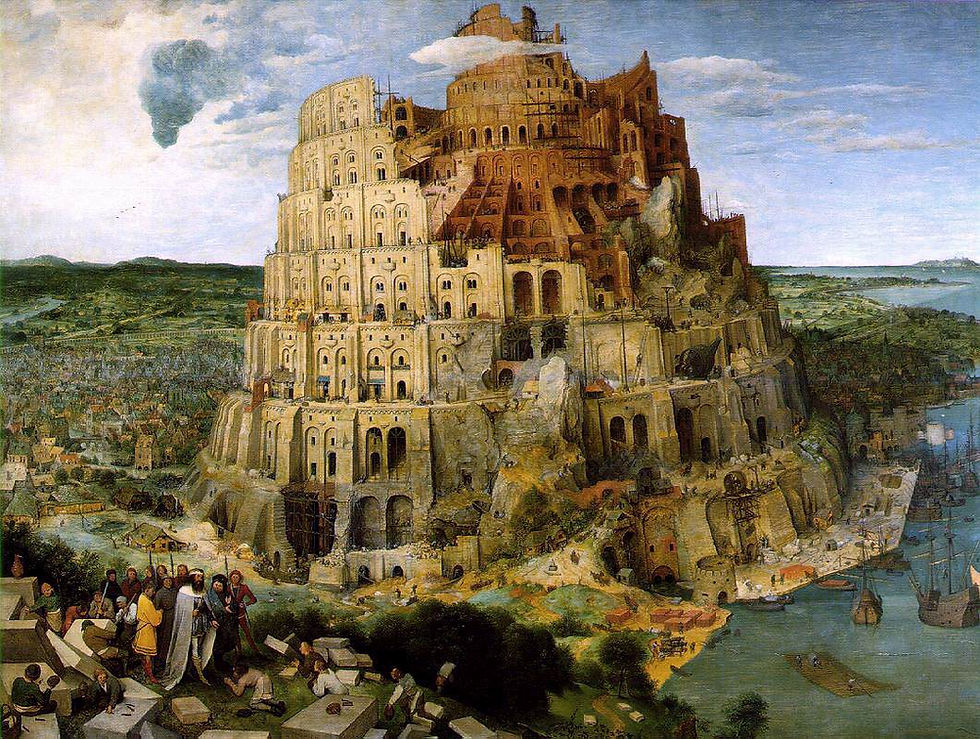
‘The whole earth was of one language and of one speech. As they travelled east, they found a plain in the land of Shinar, and they lived there. They said to one another, “Come, let’s make bricks and burn them thoroughly.” They had brick for stone, and they used tar for mortar. They said, “Come, let’s build ourselves a city, and a tower whose top reaches to the sky, and let’s make a name for ourselves, lest we be scattered abroad on the surface of the whole earth.” Yahweh came down to see the city and the tower, which the children of men built. Yahweh said, “Behold, they are one people, and they have all one language, and this is what they begin to do. Now nothing will be withheld from them, which they intend to do. Come, let’s go down, and there confuse their language, that they may not understand one another’s speech.” So Yahweh scattered them abroad from there on the surface of all the earth. They stopped building the city. Therefore, its name was called Babel, because there Yahweh confused the language of all the earth. From there, Yahweh scattered them abroad on the surface of all the earth.’ (Genesis 11:1–9). These efforts to build the tower were led by ‘Nimrod’, ‘a mighty hunter’ (Genesis 10). The use of the adjective ‘mighty’ may indicate that Nimrod was a giant or Nephilim, since the offspring of fallen angels and the daughters of men were called ‘mighty men’. Nimrod is the archetype, the first instance in a typology – a category of ideas, people or objects with similarities – of idolatrous or God-defying rulers that culminates in the Antichrist.
‘The whole earth’ is a translation of ha eretz, Hebrew for the earth, the region, the land, or the land of Israel. Given that Israel had yet to come into being at this point in history, we can take this as a reference to the region of the Middle East, rather than the entire planet earth; a planetary empire was highly improbable at this early juncture. This is the famous Tower of Babel. Shinar was in the region of Babylon, and the later Neo-Babylonian (626–539 BC) Tower of Babylon was called Etemenanki, it reached 91 metres high and was used in pagan rituals, but it is highly unlikely to have been the original Tower of Babel. ‘They are one people, and they have all one language, and this is what they begin to do.’ This was too early in history for a centralised empire that was not in conformance to God’s will. Rather than besetting Babel with plagues, God simply elected to confuse their languages, and thus began the curse of Babel, whereby the various peoples of the earth have different languages, and different cultures and customs, a measure to guard against the emergence of tyrannical one world government and keep the nations in check.
The Tower of Babel episode foreshadowed the fate of Pharaoh’s Egypt in Exodus, the Antichrist’s alliance and the wrath of God in the form of natural disasters that will reign down upon that alliance, as outlined in Revelation.
Then the Bible proceeds to list the generations of Shem. The chapter ends with Abram marrying his wife Sarai, who was sterile and childless. ‘They went from Ur of the Chaldees, to go into the land of Canaan.’ (Genesis 11:31). Abraham and the Promised Land are covered in Godmindbody: The Bible, Prophecy, Miracles, and TMS Healing Explained and Godmindfamily: The Human Mind, Behaviour, Symptoms, The Family, Society, Politics and God’s Kingdom Explained.
[i] Ibid.
[ii] Ibid.
[iii] Meyer, S. 2013. Darwin’s Doubt: The Explosive Origin of Animal Life and the Case for Intelligent Design. HarperOne.
[iv] Lennox, John. 2021. Seven Days That Divide the World, 10th Anniversary Edition: The Beginning According to Genesis and Science. HarperChristian Resources.
[v] Zondervan, Stump et al. 2017. Four Views on Creation, Evolution, and Intelligent Design (Counterpoints: Bible and Theology). Zondervan Academic.
[vi] Lennox, John. 2021. Seven Days That Divide the World, 10th Anniversary Edition: The Beginning According to Genesis and Science. HarperChristian Resources.
[vii] Cosmic Microwave Backgroud Radiation. European Space Agency. https://www.esa.int/Science_Exploration/Space_Science/Cosmic_Microwave_Background_CMB_radiation
[viii] How We Know the Universe is 13.8 billion years old. YouTube Video. Ah Documentary. https://www.youtube.com/watch?v=zgR5U_XfVLY
[x] Zondervan, Stump et al. 2017. Four Views on Creation, Evolution, and Intelligent Design (Counterpoints: Bible and Theology). Zondervan Academic.
[xi] https://www.bas.ac.uk/news/historic-drilling-campaign-reaches-ice-more-than-1-2-million-years-old/
[xii] https://www.reuters.com/science/new-method-spots-signs-earths-primordial-life-ancient-rocks-2025-11-18/
[xiii] https://en.wikipedia.org/wiki/Earliest_known_life_forms#/media/File:Stromatolite_-_National_Museum_of_Nature_and_Science,_Tokyo_-_DSC07686.JPG
[xiv] Zondervan, Stump et al. 2017. Four Views on Creation, Evolution, and Intelligent Design (Counterpoints: Bible and Theology). Zondervan Academic.
[xv] Beyond Evolution: Unraveling the Origins of Life with Stephen Meyer and James Tour. YouTube. Hoover Institution. https://www.youtube.com/watch?v=WCBHNDTEgWk&t=1501s
[xvi] Ibid.
[xvii] Zondervan, Stump et al. 2017. Four Views on Creation, Evolution, and Intelligent Design (Counterpoints: Bible and Theology). Zondervan Academic.
[xviii] Ibid.
[xix] Ibid.
[xx] Ibid.
[xxi] Lennox, John. 2021. Seven Days That Divide the World, 10th Anniversary Edition: The Beginning According to Genesis and Science. HarperChristian Resources.
[xxii] Zondervan, Stump et al. 2017. Four Views on Creation, Evolution, and Intelligent Design (Counterpoints: Bible and Theology). Zondervan Academic.
[xxiv]Zondervan, Stump et al. 2017. Four Views on Creation, Evolution, and Intelligent Design (Counterpoints: Bible and Theology). Zondervan Academic.
[xxv]https://en.wikipedia.org/wiki/Apple_maggot#:~:text=forelegs%20and%20pedipalps.-,Evolution,new%20races%20among%20its%20parasites.
[xxvi] Mauro, P. Charles, D. 2019. Darwinism Debunked: Two Classic Apologetics for Creationism in One Volume. Tole Publishing.
[xxvii] Ibid.
[xxviii] Ibid.
[xxix] Zondervan, Stump et al. 2017. Four Views on Creation, Evolution, and Intelligent Design (Counterpoints: Bible and Theology). Zondervan Academic.
[xxx] Ibid.
[xxxi] Ibid.
[xxxii] Geology Finally Makes Sense – Thanks to Noah’s Flood. Beyond Is Genesis History? Vol 4 Ep 9. Is Genesis History? YouTube video. https://www.youtube.com/watch?v=gf2yEAPBU7o&t=13s
[xxxiii] Zondervan, Stump et al. 2017. Four Views on Creation, Evolution, and Intelligent Design (Counterpoints: Bible and Theology). Zondervan Academic.
[xxxiv] Charles, R. H. ASA Books. Book of Enoch.
[xxxv] Plato. Jowett, B. 2010. Timaeus and Critias. Digireads.
[xxxvi] Ibid.
[xxxvii] Ibid.
[xxxviii] Bremner, Marlene Seven. 2021. Hermetic Philosophy and Creative Alchemy. Inner Traditions.
[xxxix] Ibid.
[xl] Ibid.
[xli] Ibid.
[xlii] https://beta.capeia.com/planetary-science/2019/06/03/disappearance-of-ice-age-megafauna-and-the-younger-dryas-impact
[xliii] Hancock, Graham. 2011. Fingerprints of the Gods. Cornerstone Digital.
[xliv] Lennox, John. 2021. Seven Days That Divide the World, 10th Anniversary Edition: The Beginning According to Genesis and Science. HarperChristian Resources.
Comments