


OPERATION WRATH OF GOD: THE RAPTURE, THE SECOND COMING, THE CAMPAIGN OF ARMAGEDDON AND THE KINGDOM OF GOD, Intro, Images, Epigraphs and Prologue
Updated: Aug 14
By Robert Ensor
This book is dedicated to Jesus, the Messiah.
Acknowledgements
I’d like to thank Jesus for helping me with this book and my mother for her constant support. I'd like to thank Penelope too for being the best.
Copyright © 2026 Robert Ensor
All rights reserved. No part of this publication may be reproduced, distributed, or transmitted in any form or by any means, including photocopying, recording, or other electronic or mechanical methods, without the prior written permission of the publisher, except in the case of brief quotations embedded in critical reviews and certain other noncommercial uses permitted by copyright law.
First published February 2026. The author’s moral rights have been asserted.
All Bible quotations, unless otherwise stated or referenced, are taken from the online World English Bible (WEB), which is in the public domain. It is available at the following link: https://ebible.org/eng-web/index.htm. Sometimes I paraphrase the Bible and when I do so, I reference the chapter and verse. Direct quotations from the WEB are indicated by quotation marks. English language Bibles are translated from Hebrew and Greek manuscripts. I am no linguist, and I don’t know any linguists, so I have had to rely on others’ translations and romanizations of the Hebrew and Greek texts. Occasionally, I have examined the original Hebrew and Greek of the Bible, zeroing in on key words where the received English translation is debatable or misses the full meaning of the original. To clarify, the WEB refers to the Antichrist, the beasts, and the False Prophet, but makes no reference to any ‘Khan’ or ‘Lavani’, which are names for the Antichrist and the False Prophet given for the purposes of this book.
Disclaimer: I am not a doctor or a therapist and nothing in this book should be considered medical advice. Nor should it be considered a substitute for diagnoses, prescriptions and treatments from qualified doctors. If you have symptoms, I recommend that you see a doctor to rule out anything serious and get proper care.
You can buy this book on amazon in ebook and paperback formats: https://www.amazon.com/dp/B0GM8QFCCC/ref=tmm_kin_swatch_0
You can also download the book for free as a pdf:
Table of Contents
Introduction
The scenario presented in this book is consonant with and based on Bible prophecy. I believe it is broadly accurate, though future events in the End Times may not happen exactly this way in every last detail. For example, some of the characters and organisations are fictional and I reserve the right to use artistic licence for storytelling purposes. For more on the Scripture behind Operation Wrath of God, see my book Godmindbody: The Bible, Prophecy, Miracles and TMS Healing Explained or read the Bible. There are Bible references peppered throughout this book, though knowledge of the Bible is not essential to follow the story.
Maps, Images and Epigraphs
Map of the Old City of Jerusalem (Palestine Survey, 1936)

Explanatory notes: The Haram al-Sharif is also known as the Temple Mount. The Golden Gate or ‘east gate’ of Ezekiel is on the eastern side of the Temple Mount. The area marked ‘Mt. Ophel’ was part of the ancient City of David, initially known as Mount Zion. The index obscures the Mount of Olives across the Kidron Valley from the Temple Mount. The Valley of Kidron is also known as the Valley of Jehoshaphat, the eschatological place of judgement. The Valley of Hinnom, Gehenna, is to the south of Jerusalem. The Church of the Holy Sepulchre marks the approximate location of Jesus’ Crucifixion (Golgotha) and Resurrection. The above map is in the public domain.
Map of the Middle East showing Israel, Egypt, Saudi Arabia, Jordan, Syria and Lebanon including Gaza, The West Bank and the Golan Heights (as of 2011, un.org, Public Domain)

Note: Petra is not marked on this map, but it is southeast of Jerusalem in southwestern Jordan.
Map of Petra’s Archaeological SitesBy Hobe/Holger Behr (2007, Public Domain)

Al Khazneh is Arabic for The Treasury and Ad-Deir is Arabic for The Monastery.
The World as Known to the Hebrews
By Lyman Coleman (1854, Public Domain)

UN Map of Iraq circa 2007 (Public Domain)

Babylon is just north of Hillah. Azim and Amir’s DZ is in Al Muthanná, the southern Desert.
Map of Ancient Babylon (Archaeological Sites), 2021
By Projectstudy - Own work, CC BY-SA 4.0, https://commons.wikimedia.org/w/index.php?curid=110476810

Processional Way, Babylon (2016)By MohammadHuzam - Own work, CC BY-SA 4.0, https://commons.wikimedia.org/w/index.php?curid=72764653
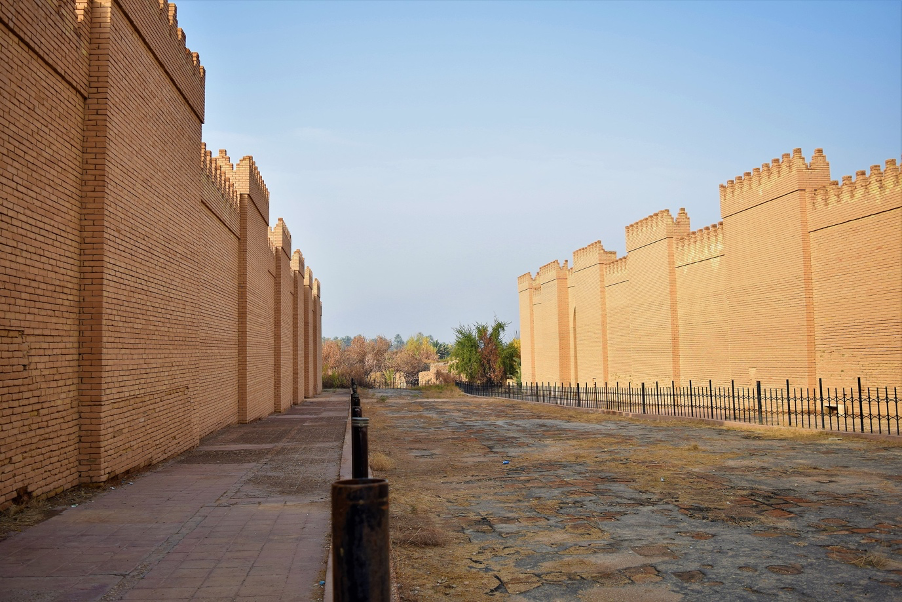
Part of Saddam’s reconstruction of Ancient Babylon.
Ezekiel’s Temple By Charles Chapiez and Georges Perrot (1887, Public Domain)

Al Khazneh (The Treasury) at Petra, Jordan
Graham Racher, 2011. CC AS-A 2.0. Modifications made by MrPanyGoff. https://commons.wikimedia.org/wiki/File:Al_Khazneh_Petra_edit_2.jpg

In that day Yahweh made a covenant with Abraham, saying, “I have given this land to your offspring, from the river of Egypt to the great river, the river Euphrates: the land of the Kenites, the Kennizites, the Kadmonites, the Hittites, the Perizzites, the Rephaim, the Amorites, the Canaanites, the Girgasites and the Jebusites.”– Genesis 15:18–21
When you shall father children, and you shall have been long in the land, and shall corrupt yourselves and make an engraved image in the form of anything, and shall do that which is evil in Yahweh your God’s sight, to provoke him to anger; I call heaven and earth to witness against you today, that you will soon utterly perish from off the land which you go over the Jordan to possess it. You will not prolong your days on it, but will utterly be destroyed. Yahweh will scatter you among the peoples, and you will be left few in number among the nations, where Yahweh will lead you away. There you shall serve gods, the work of men’s hands, wood and stone, which neither see, nor hear, nor eat, nor smell. But from there you shall seek Yahweh your god and you shall find him, when you search after him with all your heart and with all your soul. When you are in oppression, and all these things have come on you, in the latter days you shall return to Yahweh your God, and listen to his voice. For Yahweh your God is a merciful God. He will not fail you, neither destroy you, nor forget the covenant of your fathers which he swore to them.– Deuteronomy 4:25–32
It shall happen, when all these things come upon you, the blessing and the curse, and you shall call them to mind among all the nations where Yahweh your God has driven you, and return to Yahweh your God and obey his voice according to all that I command you today, you and your children, with all your heart and with all your soul, that then Yahweh your God will release you from captivity, have compassion on you, and return and gather you from all the peoples where Yahweh your God has scattered you. If your outcasts are in the uttermost parts of the heavens, from there Yahweh your God will gather you, and from there he will bring you back.– Deuteronomy 30:1–4.
Alas, for that day is great, so that none is like it! It is even the time of Jacob’s trouble; but he will be saved out of it.– Jeremiah 30:7.
Prologue: The Buried Treasure
The not too distant future
Amy Weissman struggled with the heat. She was 38 years old and elegant with vibrant, naturally red hair. She was glad she had been spared the freckles that affected other family members, but her skin was pale as ivory, and subject to prickly heat. Her mom was of auburn-haired Irish stock, and her dad was Jewish, with dark brown hair. Her maternal granddad was a carrot top. My mom’s genes must be dominant, she figured.
Amy wiped the sweat off her brow. She had long since learned to protect her delicate skin from the sun with hats and 50 SPF sunscreen, but the heat down here in Jordan was something else. The wide-brimmed brown fedora provided some protection, but it didn’t cover all of her neck, which felt worryingly hot, even with the sunscreen lathered on. The fedora was not only selected for practical reasons, but also because it was like the one Indiana Jones wore in the movies.
She thought it was appropriate, considering where she was headed.
The reddish sandstone mountains of Petra loomed ahead, in stark relief against a spotless blue sky. Amy stared in amazement at the ornate buildings, tombs, temples and houses carved into the cliff faces by the Nabataeans starting around 300 BC. Petra itself was something of a miracle and was rightly called one of the seven new wonders of the world. On the surface, it was an extremely unlikely and inhospitable location for a city, a rabbit warren of cliffs amidst a barren wilderness, without any real rivers or lakes nearby. The Nabataeans had abandoned the city in the 4th century AD, when earthquakes ruined the sophisticated hydraulic system that supplied the city with water. The closest water source was a spring in Wadi Musa, a valley named after Moses. It was believed that this was where the prophet had struck a rock with his staff, causing water to flow from it. There were two such incidents in the Bible, Amy knew.
The first time, recorded in the Book of Exodus (17:6), was done according to God’s instructions in a place called Horeb. The second occasion, in the Wilderness of Zin (Numbers 20:9–12), was an act of disobedience; God had told Moses to speak to the rock and thereby obtain water, and the prophet had hit it instead. God punished Moses by preventing him from entering the land promised to Abraham (Numbers 20:12). The great prophet died in Mount Nebo, Moab, looking at the land of Canaan, the land he could not enter because he struck the rock (Deuteronomy 34).
Amy knew that the punishment was symbolic, because Moses’ transgression had been symbolic and even prophetic. The rock represented Jesus, a stonemason who called himself the stone the builders rejected (Matthew 21:42), who gives living water to those who ask it of him (John 4:10). Moses striking the stone with his staff anticipated the rejection of Jesus by most Jews. Amy knew all of this because of the book she carried in her backpack. The book that was her reason for coming to Jordan.
I AM COMING SOON was the title. A bold title, no doubt. Even bolder when you considered the book’s message: The Second Coming of Jesus Christ. The author John Burrows, a British mystic of mysterious provenance, had self-published the book a few months ago. There was quite a bit of press last year about Burrows’ dramatic speech at the Vatican, and what some claimed was a miraculous healing there of a cardinal who had suffered from cancer that was supposed to be terminal (since then, the hubbub had died down somewhat, and Burrows had slid back into obscurity). Amy was a firm believer in doing her homework, so she looked into the incident afterwards and yes, the cardinal was sick and now appeared to be totally fine.
Amy had bought Burrows’ book out of curiosity. Her social media feed had gradually shifted from yoga and presence videos to Christian content, I AM COMING SOON promised to clearly explain the Bible, and part of her wanted to see what all the fuss was about. Since then, Amy had been thrown into a full-blown metaphysical crisis as the book had challenged her beliefs and forced her to completely re-evaluate her worldview. She had started reading the book as a non-practicing Jew who was into spirituality. By the time she finished, she was a Christian, albeit not a churchgoing one. Burrows had explained to her that salvation did not strictly require priests or churches, just God’s will and a soul prepared to let him in and serve him.
I AM COMING SOON outlined the many prophecies in the Bible that had already been fulfilled, including those surrounding Jesus’ First Advent. King David had written an accurate description of a death by crucifixion from the Messiah’s perspective (Psalm 22) in the 10th century BC, before Crucifixion was even invented. Isaiah had foretold the Virgin Birth from the 8th century BC (Isaiah 7:14), and that the Messiah would be a suffering servant, pierced (Isaiah 53:5) and killed (Isaiah 53:9) for the sins of humanity, as a substitutionary sacrificial lamb (Isaiah 53:7). The prophet Micah (5:2) had foretold a Messianic ruler would come from Bethlehem, Zechariah (11:12–13) had predicted that Yahweh would be betrayed for 30 pieces of silver – the amount Judas was paid (Matthew 26:14–15) – and even wrote that the Messiah would be called Yeshua (Zechariah 6:12), Jesus’ Hebrew name. Daniel had provided the dates of Jesus’ birth, ministry and crucifixion (Daniel 9:25), and predicted that the Messiah would be ‘cut off’ (Daniel 9:26).
Then, having established that the Bible had correctly predicted many historical events, the author proceeded to outline the prophecies of the Second Advent. ‘The Bible was right about all of that stuff which has already happened, so all the prophecies that haven’t yet materialised, are definitely going to happen’ was the gist of the book. That included all the stuff about the rapture, the Second Coming and the mass resurrection for judgement. Indeed, Daniel prophesied that ‘one like a son of man’ would come ‘with the clouds’ to rule all nations and kingdoms (Daniel 7:13–14). Since he was born of a woman and conceived by the Holy Spirit (Luke 1), Jesus is the Son of Man (Mark 2:10) and the Son of God (John 9:35–37; John 10:36), as he said. Amy believed it.
Whilst suffering from an acute bout of tonsillitis, Amy did what Burrows had recommended: pray to Christ for total healing, in the faith and knowledge that he would deliver, based on the many examples of miracles in Scripture. As Jesus said, ‘“if you have faith as a grain of mustard seed, you will say to this mountain, ‘Move from here to there’, and it will move; and nothing will be impossible for you.”’ (Matthew 17:20). Within the hour, her fever had broken, and her symptoms had completely cleared up. She was convinced.
She read the Gospel of John and began to understand salvation: Jesus the Son of God is one with the Father (John 10:30), God the Father is spirit (John 4:24), the spirit is the life (John 6:63), the ‘pledge’ (Ephesians 1:14) and guarantee of eternal life to those who receive it, and ‘if you don’t eat the flesh of the Son of Man and drink his blood, you don’t have life in yourselves’ (John 6:53), because Jesus is the only one who currently has an immortal, glorified body that has been offered for consumption. Those who received the spirit and kept it in righteousness until death would go to heaven and would pass the Last Judgement, with the reward of eternal life in immortal resurrection bodies on the new earth (Revelation 21:2). These individuals were saved, in that they were safe from destruction on Judgement Day. Those without the spirit would die and go to Sheol – the place of the dead a.k.a Hell – to await the judgement, and on that day they would be cast into the lake of fire, their souls and bodies destroyed utterly in the ‘second death’ (Revelation 20:14–15), because after death and Hades are thrown in the fire, ‘death will be no more’ (Revelation 21:4–5). Therefore, when something goes into the lake of fire, it no longer exists. Amy had called upon Jesus’ name, received the Body of Christ mixed with the Spirit of God, and felt the presence within her head. Then she knew it was all true; Jesus was the Messiah and the Son of God and the Bible which had led her to this very real and physical experience was divinely inspired holy writ.
A week ago, when she was lying in her bed at night, and her husband and children were asleep, Amy had left her body behind and been taken up in the spirit to heaven. There, she had come before the Father and the Son on their thrones. God, the Father himself, had shown her a vision of herself burying an English language Bible, a Hebrew Bible and I AM COMING SOON in the sands of Petra, Jordan. She saw those books being picked up and dusted off by what looked like an elderly rabbi wearing a kippah (skullcap). As he read, his eyes widened.She instantly recognised Petra because it was the subject of her PhD in Architectural History from the University of Ann Arbor; she had visited the place three times before, on her semester abroad, and its layout was engraved on her soul from years of dedicated research.
The Father instructed Amy to do as she had seen in the vision. He told her that a remnant of Israel would survive the coming tribulation (Jeremiah 50:20), a prophesied future period of strife, persecution, war and calamity. This remnant would ‘flee to the mountains’ (Matthew 24:16) of Petra from the Antichrist’s persecution, find the book and read it, and be converted as she converted, and call upon the name of the Lord Jesus for help, and acknowledge him as their Messiah, as was stated in the Bible and I AM COMING SOON. Then the Jerusalemites will follow suit, as it was written in Zechariah (10:12): ‘I will pour on David’s house and on the inhabitants of Jerusalem a spirit of grace and supplication. They will look to me whom they have pierced, and they will mourn for him as one mourns for his only son.’ The Lord would share his spirit with the Israeli remnant (Isaiah 44:3), and Jesus would return to save them from the Antichrist’s armies, before proceeding to Jerusalem with his raptured saints in their immortal glory bodies, where they would relieve the Holy City from the Antichrist’s main force, and kill him, and burn him alive, and shackle the devil, and set up God’s Kingdom for ‘one thousand years’ (Revelation 20:6), in preparation for the mass resurrection, the Last Judgement and finally the New Jerusalem, as was foretold by his servants the prophets.
In the Bible, God’s kingdom has three meanings: 1) the Kingdom of Heaven, a kingdom ‘not of this world’ (John 18:36) that believers go to upon death and visit in rebirth experiences; 2) the millennial kingdom, a thousand year reign of Jesus and the saints (Revelation 20:4) ‘on earth’ (Revelation 5:10; Daniel 2:35); 3) the New Jerusalem, an eternal state on a ‘new earth’ (Revelation 21:1–2) made of a new substance derived from the sacred marriage of spirit and matter. Indeed, I AM COMING SOON emphasised that the worldwide events of the End Times were to be a macrocosm of what happened to an individual who is saved following a time of suffering: the person appeals to Christ, the demonic is kicked out on its ear and Jesus is welcomed into the body as the master, since the body is the new temple of the Holy Spirit (1 Corinthians 6:19).
At first, Amy was quite distressed by the vision. But she knew too much to write it off. Burrows had laid the groundwork by reiterating the prophecy of Micah (2:12): ‘I will surely assemble all of you Jacob, I will surely gather the remnant of Israel. I will put them together as the sheep of Bozrah, as a flock in the middle of their pasture.’ And the prophecy of Isaiah (63), in which a saviour figure comes from ‘Bozrah and Edom’, covered in blood.
Burrows gave several reasons for identifying Petra as the biblical Bozrah in I AM COMING SOON. Bozrah meant sheepfold in Hebrew, Petra was shaped like a sheepfold with its narrow passes, it therefore satisfied Isaiah’s (33:16) criterion of defensibility, it was in Edom (modern-day southwestern Jordan), where the saviour was prophesied to come from, and was close to places called Butseira and Busaira, which sounded a lot like Bozrah. The many tombs, buildings and cliffs of Petra would provide shelter from various tribulation hazards, such as the massive demonic army (Revelation 9:16), the fire from heaven (Revelation 16:8), the lightning and the large hailstones (Revelation 16:21). And the prophet Daniel (11:41) had predicted that Edom, Moab and Ammon’s children would be outside the Antichrist’s dominion; Moab corresponded to western Jordan and the name of Jordan’s capital Amman was derived from Ammon and the Ammonites. On a second reading, Amy was convinced that she had the right place.
Burrows had stressed that it was not merely belief in Jesus that saved, but that faith and belief in several key passages about what is required for salvation (John 6:29; John 5:24; John 6:40; Romans 10:9) were translations of the Greek word pisteou, which meant not only belief, but implied that actions would be taken on the basis of that belief.[i] It wasn’t enough to mentally accept Jesus as God and talk the talk; you have to walk the walk, even when it is unpopular or difficult. Matthew 7:21: ‘“Not everyone who says to me ‘Lord, Lord’, will enter into the kingdom of heaven, but he who does the will of my Father who is in heaven.’ John 3:36: ‘one who disobeys the Son won’t see life, but the wrath of God remains on him.’ John 15:1: ‘I am the true vine and my Father is the farmer. Every branch in me that doesn’t bear fruit, he takes away.’ The parable of the sheep and the goats (Matthew 25) had driven the point home. The sheep who had helped Jesus’ ‘brothers’ (who shared his blood, Matthew 25:40), were saved at the judgement, while the goats who had not helped Jesus’ brothers, and had mistreated them, were condemned to the fire. When you really understood it, life was very simple and could be boiled down to a binary choice. Christ or the devil. Eternal life, or eternal death.
One message from the Bible that came through very clearly was that when God told you to do something, you’d better do it. During a sleepless night, Amy yielded to God. She had to do her part. All it involved was a simple trip to one of her favourite places, after all. Hiding the book without being seen would be a bit trickier, but she knew the site well, and already had a place in mind.
The next morning, Amy booked a flight to Amman, Jordan. Her husband Mike was a little surprised, but he was an agreeable type and managed to get the time off work on late notice thanks to a co-worker with a hefty mortgage who was eager for overtime. Amy’s mom agreed to look after the kids. The way was being prepared, the highway (or rather, runway) of the Lord in the wilderness (Isaiah 40:3).
Amy’s mission was to help God save the remnant, and therefore the world, and she could almost physically feel the weight of that responsibility on her shoulders. Just as Indy had solved a series of entertaining riddles in Petra in order to drink from the Holy Grail and save his father, the remnant would have to understand the riddles of the Bible, and their reward would be the real Holy Grail, the spiritualised blood of Christ, which is given to whoever asks for it in faith. ‘God speaks through movies, whether the filmmakers know about it or not’, wrote Burrows in I AM COMING SOON. But for the remnant to do all of that, they needed the books Amy carried with her in her backpack.
Amy looked over her shoulder. While she was struggling with the heat, her husband was drenched in sweat and panting for air. Mike was not overweight, but he had some visceral fat on account of his completely sedentary lifestyle. He worked in IT.
‘You okay, hon?’
‘Sure,’ Mike gasped. ‘Go ahead. I’ll catch up,’ he said, leaning against a pillar and positioning himself in its shade as he frantically unscrewed the cap on his water bottle. The Petra complex was pretty big and surprisingly difficult to traverse in the summer heat.
Amy walked by a stairway leading to a large platform fringed by freestanding sandstone pillars of varying heights. The structure was once a large temple, she knew. The cliffs gradually began to encroach as she walked the sandy road. A pick-up truck churned past, choking her with its dust. Afterward, she could feel the gritty crunch of the sand particles in her mouth.
She passed the Nabatean theatre, carved out of the stone like a Roman amphitheatre, a huge ornate tomb chiselled into the rock, and a Bedouin trying to sell some trinkets. He offered her a little stone statuette; a figurine inspired by the statues adorning the buildings here. Amy shook her head, her mind flashing to the Israelites’ erroneous worship of the golden calf (Exodus 32), and the terrible things that followed. The man rose and thrust the statue at her, saying ‘Good price! Souvenir!’ in broken English. ‘No,’ she said, feeling very much tested.
Sensing the firmness in her voice, he backed off and slumped back down on his rock.Amy entered the narrow Siq gorge, the gate of God’s sheepfold. As she did so, she felt the hairs stand up on the back of her neck. It had been fifteen years since her last visit, but after reading Burrows’ book and the Bible, these rocks were invested with a significance that had escaped her before.
It was much cooler in the indigo shade of the smooth, high cliffs. Amy proceeded through the winding gorge until at last, the way opened up and she saw The Treasury built into the cliff face. It was a filming location for Indiana Jones and the Last Crusade. No wonder, she thought, it’s highly photogenic, with the ornate rose-coloured façade, the cliff and the stark blue sky above. The Treasury looked incongruously Greco-Roman with its columns, statues, capitals, cornice and triangular pediment. But the Romans did not normally carve their structures out of the rock, the way The Treasury had been painstakingly chiselled. Building The Treasury must have been a monumental effort, Amy reflected, and not for the first time. However, the Nabataeans could afford the manpower, given the wealth they accrued from the frankincense and myrrh trade. Nabatean architecture was eclectic, borrowing influences from east and west encountered as a result of that trade.
But The Treasury was not really a treasury, Amy knew. It was a tomb. The name was derived from legends surrounding the urn near the apex of the façade; in reality, it is not an actual urn, it is just an architectural feature carved out of sandstone like the rest of the structure. It has bullet holes in it from the time some Bedouin had mistakenly tried to shoot it down in a bid to retrieve treasure. There was another legend that Pharaoh and some of his army had survived the closing of the Red Sea and stored treasure here. Amy didn’t believe it: Exodus 14:23 stated, ‘there remained not so much as one of them.’
Staring at The Treasury, Amy was reminded of the parable of the hidden treasure. ‘Again, the kingdom of heaven is like treasure buried in a field which a man found and hid. In his joy, he goes and sells all he has and buys that field.’ (Matthew 13:44). The only treasures here were the architecture and the book she was burying. Or rather, the book was not the treasure, but the detailed map, that would lead to the true treasure, Jesus.
It was forbidden to enter The Treasury, but that was not Amy’s true destination. Not exactly. There was a little alcove at the bottom of the cliff face. A rectangular hole, about three feet wide and one foot high, carved by the Nabateans for some mysterious purpose. Amy looked around. She had come early, before the crowds. At this time of day, there were only a few tourists and Bedouin hanging around. A camel was lying down in the gorge. The four tourists were all gazing awestruck at The Treasury that wasn’t a treasury, and the Bedouin was getting something from his camel’s saddle.
Now is my chance, she figured. As the day wore on, it would only get busier. She took a deep breath, slipped her backpack off and walked over to the low alcove. After a last scan for people watching, she unzipped her backpack and took I AM COMING SOON out. The cover was a reproduction of the painting of Jesus Healing the Blind Man, by Václav Mánes. It was symbolic, of course, like the miracle itself.
Amy hastily buried the books in the sand within the hole and covered them with some small rocks. They were protected from the elements by the cliff. She stood up, dusted off her hands, and looked around again. The tourists were still taking photos. The Bedouin was patting his camel. She breathed a sigh of relief. Felt a tremendous pressure lifting from her. She’d had a brief taste of what it was like to have the weight of the world on her shoulders, and she was glad it was over. For a few weeks, millions of souls had relied on her, though they knew it not. Hers was a covert battle fought in obscurity, in the mind, against that part of herself that was the devil, the inner voice of fear, temptation and doubt. The experience had given her more sympathy with Christ, especially during his First Advent, when he was clothed in vulnerable flesh, and said: ‘But I have a baptism to be baptised with, and how distressed I am until it is accomplished.’ (Luke 12:50). The book was no longer her cross to bear. Her part was done.
‘Over to you, Lord,’ she said.
Read the next chapter free here:
Or buy the book on amazon in paperback or ebook format: https://www.amazon.com/dp/B0GM8QFCCC/ref=tmm_kin_swatch_0
Comments